
Blog
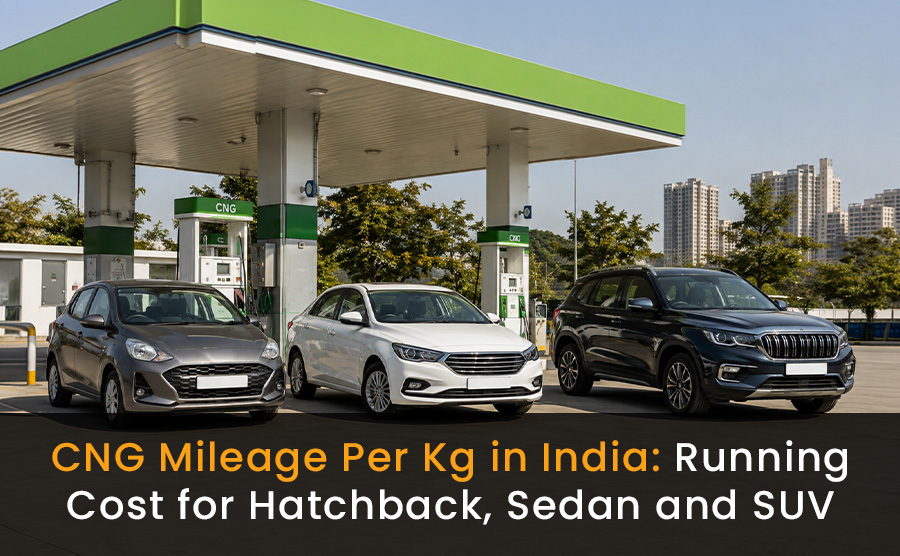
CNG Mileage Per Kg in India: Running Cost for Hatchback, Sedan, and SUV
Fuel expenses can make up a significant part of the monthly budget for people who drive regularly. This is one reason many vehicle owners consider CNG as a practical fuel option for managing everyday running costs.
Before choosing a CNG vehicle, it is useful to understand its CNG mileage per kg. Unlike petrol and diesel, CNG is generally measured by weight, so vehicle mileage is expressed in kilometres per kilogram, or km/kg.
However, the mileage mentioned by the manufacturer may differ from what you experience during daily driving. Factors such as your vehicle model, traffic conditions, driving habits, passenger load, air-conditioning use, and vehicle maintenance can all affect actual fuel consumption.
So, what kind of CNG mileage can you expect from a hatchback, sedan, or SUV? More importantly, how can you calculate your actual CNG running cost per km? Understanding these numbers can help you make a more informed decision about your vehicle and monthly fuel expenses.
What Does CNG Mileage Per Kg Mean?
CNG mileage per kg tells you how many kilometres your car can travel using one kilogram of compressed natural gas. It is usually written as km/kg.
For example, if a CNG car delivers 25 km/kg, it can travel approximately 25 kilometres using one kilogram of CNG under those particular driving conditions. This figure helps you understand the vehicle’s fuel efficiency and estimate its running cost.
However, your actual CNG mileage may be different from the figure mentioned by the manufacturer. Everyday factors such as traffic, road conditions, frequent stops, acceleration, passenger load, and air-conditioning use can affect fuel consumption.
For instance, a car may deliver better mileage during a steady highway drive than in heavy city traffic. Therefore, it is better to treat the claimed mileage as a reference and track your actual mileage over several refills for a more realistic estimate.
Average CNG Mileage for Hatchbacks, Sedans, and SUVs
The CNG car mileage you get depends on several factors, including the engine, vehicle weight, transmission, tyre condition, and driving conditions. In general, smaller and lighter vehicles tend to use less fuel, while larger vehicles may consume more CNG because of their greater weight and engine requirements.
As a broad reference, the following ranges can help you understand what to expect:
| Vehicle Type | Approximate CNG Mileage |
|---|---|
| Hatchback | 20 to 30 km/kg |
| Sedan | 20 to 28 km/kg |
| SUV | 15 to 25 km/kg |
These are indicative ranges, not guaranteed figures. Actual mileage can vary from one model to another and may also change with traffic, road conditions, driving habits, and vehicle load.
CNG Mileage for Hatchbacks
CNG hatchbacks are commonly preferred for daily city driving because they are generally lighter and compact. Depending on the model and driving conditions, a hatchback may deliver around 20 to 30 km/kg.
For example, if you drive 40 kilometres every day, a car delivering 28 km/kg would need less CNG than one delivering 20 km/kg for the same distance. Over several weeks, this difference can affect your overall CNG running cost.
CNG Mileage for Sedans
CNG sedans can provide a practical balance between fuel efficiency, cabin space, and driving comfort. Depending on the engine and vehicle configuration, a sedan may deliver around 20 to 28 km/kg.
However, actual CNG mileage can vary considerably. A sedan driven mainly on open highways may deliver better mileage than the same vehicle used in stop-and-go city traffic. Carrying more passengers or luggage can also increase fuel consumption.
CNG Mileage for SUVs
CNG SUVs are generally heavier than hatchbacks and may have larger engines, which can result in lower CNG fuel efficiency. Depending on the vehicle and driving conditions, a CNG SUV may deliver around 15 to 25 km/kg.
However, lower mileage does not necessarily make an SUV a poor choice. Buyers may choose an SUV for its larger cabin, higher seating position, and greater space. If those features match your needs, you can compare the expected mileage with your daily distance to understand the likely CNG running cost per km.
How to Calculate CNG Running Cost Per Km
Knowing your CNG mileage per kg can help you estimate how much you spend on fuel for every kilometre you drive. The calculation is simple. Divide the current price of one kilogram of CNG by your car’s mileage in km/kg.
For example, if CNG costs ₹80 per kg and your car delivers 25 km/kg, your approximate fuel cost would be:
₹80 ÷ 25 = ₹3.20 per kilometre
If you drive around 1,000 kilometres in a month, your estimated CNG fuel expense would be approximately ₹3,200.
However, this is only an estimate. Your actual CNG running cost per km can change depending on the CNG price in your city and the mileage your vehicle delivers in real-world conditions.
You can also use IOAGPL’s CNG mileage and cost calculatorto estimate mileage and fuel cost based on your distance travelled, CNG consumed, and fuel price.
Tracking your fuel consumption over multiple refills can give you a more accurate monthly estimate.
How Driving and Maintenance Affect CNG Mileage
The mileage mentioned by a manufacturer can help you compare vehicles, but your actual CNG car mileage may be different. Everyday factors such as traffic, driving style, vehicle condition, and even the amount of luggage you carry can affect how efficiently your car uses CNG.
1. Driving Conditions
Heavy traffic, frequent stops, braking, and repeated acceleration can increase fuel consumption. On the other hand, maintaining a steady speed with fewer stops can help your car deliver better CNG mileage.
2. Air Conditioner Usage
Using the air conditioner for long periods can increase fuel consumption, particularly during hot weather and slow-moving traffic. This does not mean you should avoid using it, but it can affect your overall mileage.
3. Vehicle Load
A car carrying several passengers or heavy luggage needs more energy to move. If you regularly drive with a heavy load, you may notice a reduction in CNG fuel efficiency.
4. Tyre Pressure
Incorrect tyre pressure can increase rolling resistance and make the engine work harder. Checking your tyre pressure regularly according to the manufacturer’s recommended level can support better mileage.
5. Vehicle Maintenance
The condition of your engine and other components can also affect fuel consumption. Regular servicing, proper tyre alignment, clean filters, and timely replacement of worn components can help the vehicle operate efficiently.
Following proper CNG vehicle maintenance for better mileage can also help maintain fuel efficiency, engine performance, and the condition of CNG-system components.
6. Driving Habits
Sudden acceleration, harsh braking, unnecessary idling, and consistently driving at high speeds can increase fuel usage. A smoother and more controlled driving style can help improve your CNG mileage per kg over time.
Tips to Get Better Mileage From Your CNG Car
Getting better CNG mileage does not always require major changes to your vehicle. Simple driving habits and regular maintenance can help your car use fuel more efficiently.
Some practical steps include:
- Maintain the recommended tyre pressure and check it regularly.
- Avoid sudden acceleration, harsh braking, and unnecessary high-speed driving.
- Switch off the engine if you are stopped for a long period.
- Follow the manufacturer’s recommended servicing schedule.
- Avoid carrying unnecessary luggage or heavy items.
- Keep the air filter, spark plugs, and other important components in good condition.
- Use CNG from reliable and authorised fuel stations whenever possible.
For more detailed maintenance guidance, you can also read these CNG car maintenance tips.
It is also helpful to track your CNG mileage per kg over several refills rather than relying on a single trip. This gives you a more realistic idea of your vehicle’s average fuel consumption and helps you identify changes in mileage over time.
How Cost-Effective Is CNG for Daily Driving?
For people who drive regularly, the CNG running cost per km can make CNG a practical option for managing fuel expenses. However, the actual savings depend on factors such as the CNG price in your city, your vehicle’s mileage, and how many kilometres you drive each month.
For example, someone travelling 50 to 60 kilometres every day may see greater savings than someone who drives only occasionally. Over time, regular driving can make differences in fuel cost more noticeable.
Lower running costs and fuel efficiency are among the key benefits of CNG for regular vehicle users.
However, fuel price is not the only expense to consider. The purchase price of a CNG vehicle or CNG conversion cost, maintenance, insurance, and access to nearby CNG stations can also affect the overall cost.
Before making a decision, compare the complete running expenses with your current vehicle. This gives you a more realistic idea of whether CNG fits your driving needs and budget.
How to Compare CNG Mileage With Your Current Car
If you already own a petrol or diesel car, comparing its running cost with a CNG vehicle can help you understand the potential difference in fuel expenses. Instead of relying only on claimed mileage figures, use your actual driving pattern.
Start by checking:
- Your average monthly driving distance
- Your current vehicle’s actual mileage
- The current petrol or diesel price
- Expected CNG mileage for the vehicle
- The latest CNG price in your area
Next, calculate the CNG cost per km and compare it with what you currently spend on fuel for every kilometre. For example, if your existing car costs ₹6 per kilometre to run and a CNG car costs ₹3 per kilometre, the difference becomes easier to understand.
This simple comparison can help you estimate potential savings more realistically.
If you are considering converting an existing petrol vehicle instead of purchasing a factory-CNG car, read IOAGPL’s guide on converting a petrol car to CNG to understand compatibility, CNG kits, installation, and other considerations.
Check CNG Station Availability Before Choosing CNG
Mileage and running cost are important, but CNG also needs to be easily available along the routes you use regularly.
Before choosing or converting a vehicle, check whether there are convenient CNG stations near you, particularly around your home, workplace, and frequently travelled routes.
Easy access to CNG stations can make a significant difference to the practicality of using a CNG vehicle for everyday driving.
Conclusion
The CNG mileage per kg you get depends on several factors, including your vehicle type, engine, driving conditions, maintenance, and driving habits. As a general reference, hatchbacks may deliver around 20 to 30 km/kg, sedans around 20 to 28 km/kg, and SUVs around 15 to 25 km/kg, although actual mileage can vary between models and road conditions.
Knowing your vehicle’s real-world mileage also helps you calculate the CNG running cost per km and estimate your monthly fuel expenses more accurately.
If you are considering a CNG car, mileage should not be the only factor you compare. Consider your daily travel distance, CNG station availability, vehicle size, maintenance needs, and local fuel prices.
Looking at these factors together can help you decide whether a CNG vehicle is a practical and cost-effective choice for your regular driving needs.